Free online boiler feed pump calculator for quick and accurate pump sizing
Find your job in Sri Lanka

If you’re working with boilers whether in a power plant, factory, or even a mechanical engineering project you already know one thing: choosing the right feed pump is critical.
But here’s the problem.
Most people either:
That’s exactly why we built this boiler feed pump calculation tool.
With just a few inputs, you can instantly calculate:
No complicated math. No confusion.
A boiler feed pump is used to supply water into a boiler at high pressure.
Since boilers operate under pressure, the pump must:
In simple terms, this pump is the heart of the boiler system.
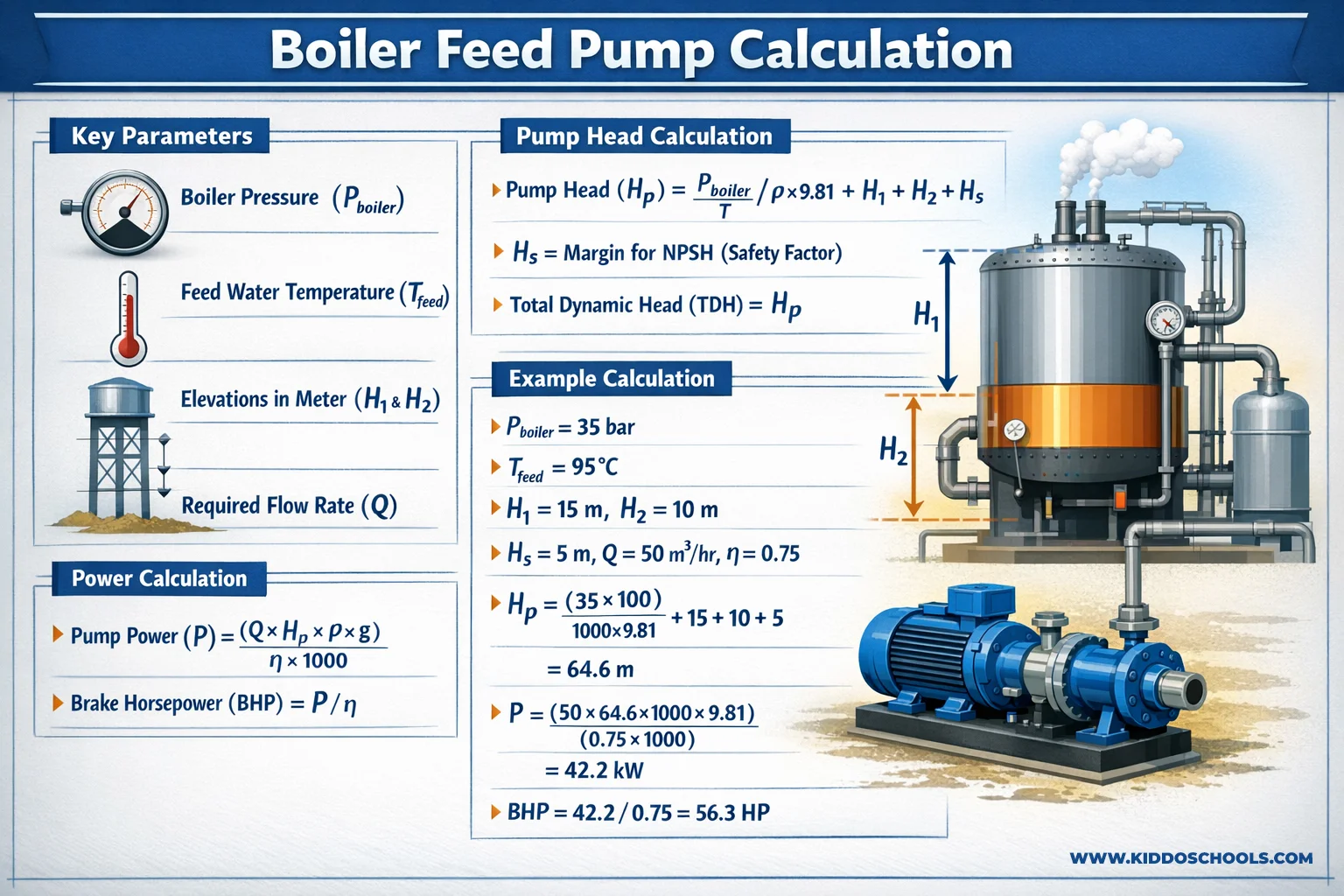
To properly size a boiler feed pump, you need to calculate three main things:
This tells you how much water the pump needs to deliver.
👉 Formula:
Flow Rate (m³/hr) = Boiler Capacity ÷ 1000
This represents the pressure the pump must overcome.
👉 Formula:
Head (m) = Pressure (bar) × 10
This determines how much energy the pump requires.
👉 Formula:
Power (kW) = (Flow × Head × Density × Gravity) ÷ Efficiency
Using the tool above is very straightforward:
Within seconds, you’ll get:
This helps you choose the correct pump without manual calculations.
Let’s say you have:
👉 This means you need a pump capable of delivering around 12 m³/hr at 80 meters head.
A wrong pump selection can cause serious problems:
Using a boiler feed pump calculator helps you:
✔ Avoid costly mistakes
✔ Improve efficiency
✔ Save energy
✔ Ensure system reliability
Even experienced users make these mistakes:
Always consider pump efficiency this directly affects power.
Make sure pressure is in bar, not PSI.
Real systems include pipe losses (advanced calculation).
If you want more accurate results:
👉 These small adjustments make a big difference in real-world applications.
To fully design your system, you may also need:
👉 These can be added to your website later (SEO cluster strategy 💰)
A proper boiler feed pump calculation is essential for any efficient boiler system.
Instead of relying on manual formulas or guesswork, you can now:
👉 Use the calculator above and make smarter engineering decisions.